Choosing a hoist by tonnage alone can produce slow lifting, premature wear, unsafe headroom, or an overloaded supporting structure. You will be able to match the hoist mechanism, duty class, controls, crane arrangement, installation requirements, and supplier quotation to the work your facility actually performs.
Key takeaways
- Calculate capacity from the heaviest load, lift frequency and duty cycle.
- Match drum, rope guide and hook travel to the crane arrangement.
- Check headroom, runway loads, power supply and maintenance access before ordering.
- Request test records, a complete specification and a defined service plan.
How an Electric Wire Rope Hoist Moves a Load
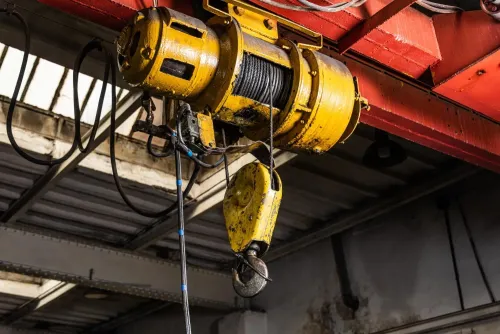
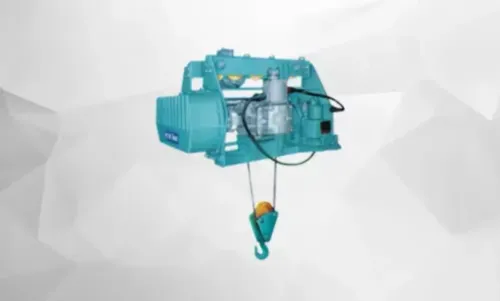
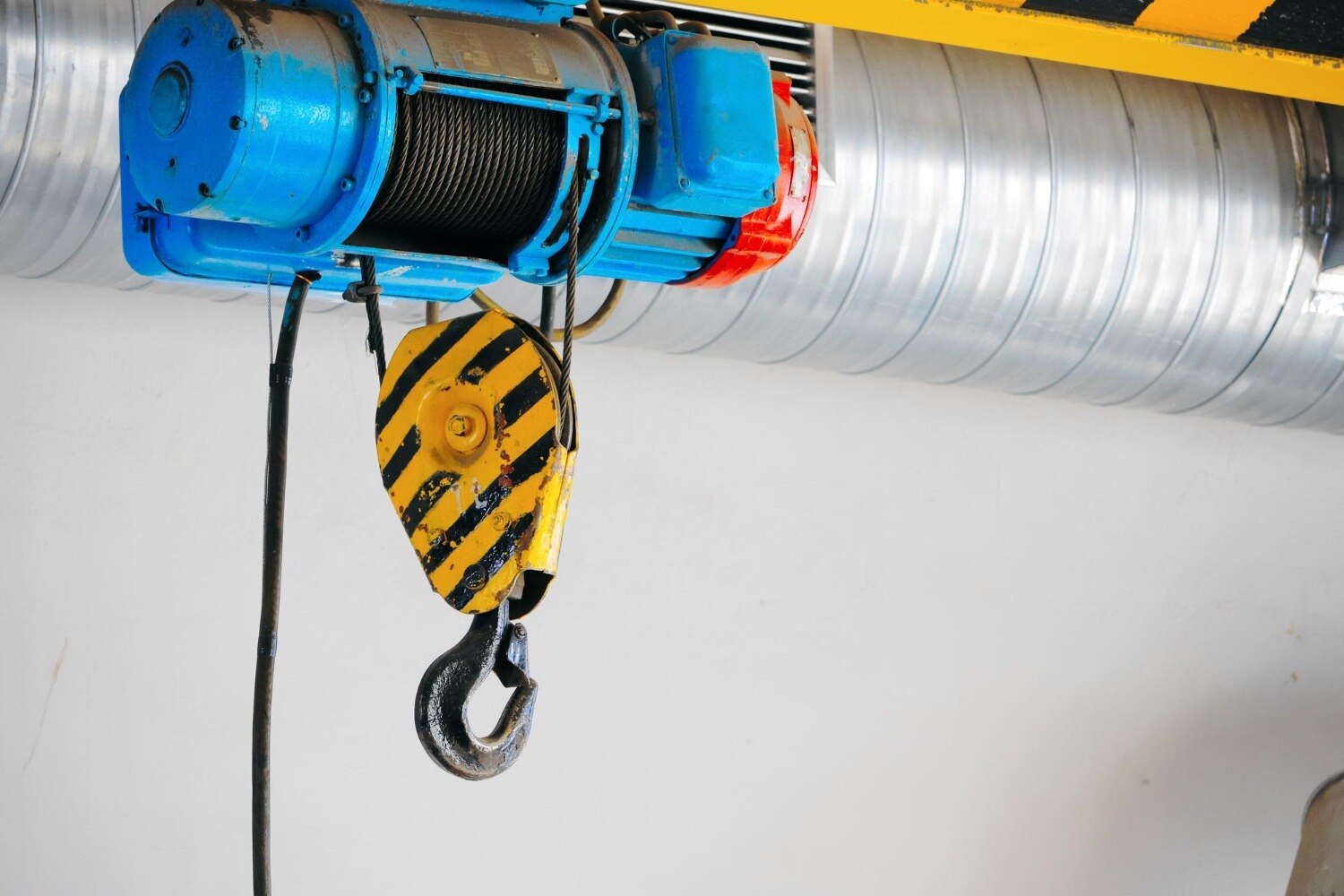
An electric wire rope hoist moves a load by driving a motor through a gearbox to rotate a grooved drum. The drum winds or pays out wire rope through a rope guide, raising or lowering the hook block.
A brake holds the load when power stops; upper and lower limit switches stop travel at unsafe positions. A pendant or radio control commands direction, speed and emergency stop.
Before comparing electric wire rope hoists in Ahmedabad, record the operating facts that determine the design:
- Duty class first: average lifts per hour, average load, lift height, starts per hour, operating hours per shift and travel frequency. A 3-tonne hoist running continuously can need higher duty than a 5-tonne intermittent unit.
- State maximum load, working load, tare weight and dynamic effects. Include hooks, slings, shackles, magnets, grabs and spreader beams within rated capacity.
- Give load geometry, centre of gravity, pick points, positioning accuracy, swing consequences, ambient temperature, dust and humidity.
- Request the declared FEM or ISO class and calculation basis, plus IS 3938 edition, reeving, brakes, limits and test requirements.
Electric wire rope hoists suit different problems than these alternatives:
| Option | Strength | Limitation |
|---|---|---|
| Electric chain hoist | Compact, moderate lifts | Less suitable for high capacity or long lift |
| Hydraulic hoist | High force in harsh systems | Needs hydraulic power and maintenance |
| Manual hoist | Simple, low-use lifting | Slow and operator-dependent |
| Winch | Pulling or inclined hauling | Hook load control and vertical lifting differ |
Select Capacity and Duty from the Real Lifting Cycle
A 5-tonne hoist used for occasional maintenance may need a lower duty class than a 3-tonne hoist feeding a fabrication line all day. Choose the FEM or ISO duty classification before capacity; it reflects both total operating time and load spectrum.
Record the real cycle:
- Maximum load, average load and tare weight
- Average lifts per hour and starts per hour
- Lift height, trolley travel distance and operating hours per day
- Required lifting and lowering speed
- Ambient temperature, dust, moisture and corrosive exposure
- Load geometry, centre of gravity, pick points and positioning accuracy
Rated capacity covers the lifted load at the specified reeving and configuration. Add the weights of hooks, slings, shackles, spreader beams, magnets or grabs; a 5-tonne rating does not permit a 5-tonne payload plus a 600-kilogram lifting beam.
| Control | Best fit | Main check |
|---|---|---|
| Pendant | Fixed workstation and simple paths | Operator visibility and cable reach |
| Radio | Multiple positions or obstructed areas | Emergency stop, signal reliability and battery management |
| Cabin | Large cranes and frequent travel | Operator sightlines, access and communication |
Select speed for the process, not only productivity. A variable-frequency drive smooths acceleration, deceleration and positioning, but it does not increase capacity; check motor cooling at low speed, brake operation and emergency stopping.
For lifting in Ahmedabad and material handling in Ahmedabad, have an engineer check runway beams, brackets, columns and foundations for wheel loads, surge, skewing, deflection and fatigue. A payload-only selection can overload the building.
Match the Hoist to the Crane Arrangement and Environment
Choose the crane arrangement before choosing the hoist: a fixed lifting point, runway, open yard, workstation, or pulling route demands different equipment. For hoists in Ahmedabad, match the choice to duty, positioning accuracy, load swing, dust, heat, moisture and available structure—not payload alone.
| Option | Appropriate choice | Main limitation |
|---|---|---|
| Standalone electric wire rope hoist | One fixed lifting point or existing monorail where loads move vertically | It does not provide bay-wide travel without a supporting trolley or crane |
| EOT crane | Enclosed production bay needing cross-travel and long travel between machines, stores or lines | The runway, columns and foundations must carry wheel loads, surge and fatigue |
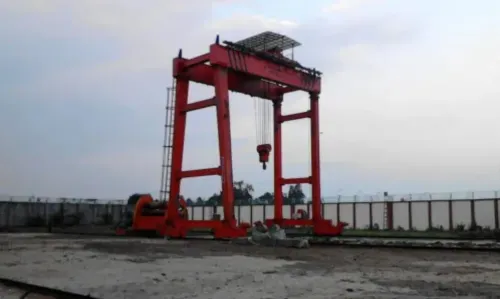
| Gantry or Goliath crane | Outdoor yards or buildings without a suitable overhead runway | Ground rails, foundations and weather protection need attention |
| Jib crane | Repeated lifting within one workstation or a defined circular reach | Its radius and column or wall capacity limit coverage |
| Electric chain hoist | Light-to-medium, frequent workstation lifting where compact equipment and short lifts matter | It is a poor fit for very high lifts, heavy duty or abrasive environments |
| Hydraulic hoist | Heavy or harsh-duty lifting where hydraulic power already exists | Hydraulic power units add hoses, heat, leakage points and maintenance |
| Manual hoist | Infrequent maintenance lifting where power is unavailable | Slow operation makes it unsuitable for production throughput |
| Winch | Pulling or hauling over a route, such as reels or vehicles | Do not use it for suspended loads unless its design, anchorage and controls are rated for lifting |
For lifting in Ahmedabad, state whether the load needs vertical lifting, controlled travel or pulling. The quotation should identify IS 3938 for the hoist or IS 3177 for an overhead or gantry crane, plus duty class, reeving, brakes and limit devices. A two-fall or four-fall arrangement increases capacity but reduces hook speed.
Confirm Headroom, Runway Loads, Power and Maintenance Access
A 5-tonne load does not tell you whether the building can carry the crane. In material handling in Ahmedabad, provide a site survey with these facts:
- Clear floor-to-roof height, beam depth, lowest obstruction and required hook height
- Required minimum hook approach at each end and along the runway
- Runway span, rail gauge, bay length and column locations
- Supporting beam, brackets, columns and foundations, including allowable vertical wheel loads
- Building deflection limits, horizontal surge, skewing forces, local flange stresses and fatigue condition
- Supply voltage, phase, frequency, available fault level and the proposed panel location
- Cable route, festoon or conductor-bar clearance, earthing point and control-station position
- Maintenance access for brakes, rope drum, rope guide, motor, gearbox and electrical panel
- Load geometry, centre of gravity, lifting points, positioning accuracy and the consequence of load swing
Ask for a dimensioned general-arrangement drawing showing the complete top-of-hoist envelope, trolley wheels, hook upper limit, beam depth and electrical clearances. A body-height measurement alone can leave the hook too high or the festoon colliding with the roof.
Send the manufacturer in India the average lifts per hour, starts per hour, lift height, travel distance, operating hours and ambient temperature. Compare the same duty class and power system; a cheaper quotation can exclude runway steel, electrification, installation or testing.
Hi-Tech Industries can use these site dimensions to separate a hoist fit from a structurally unsafe assumption.
Related product
 | Electric Wire Rope Hoist Hi-Tech Electric Wire Rope Hoists are heavy-duty industrial material handling systems engineered for optimal wear resistance, precise control, and... View product → |
Demand a Complete Specification, Test Record and Service Plan
Compare quotations only after making every bidder state the same duty. For electric wire rope hoists in Ahmedabad, require the applicable edition of IS 3938; identify IS 3177 when the hoist forms part of an overhead travelling or gantry crane.
A manufacturer in India and an importer must disclose exclusions for runway steel, electrification, installation, testing and commissioning.
| Quotation field | Record precisely | Why it matters |
|---|---|---|
| Duty and cycle | Duty class, average load, lifts/hour, starts/hour, hours/day | Exposes an undersized hoist |
| Motion | Rated load, lift, lifting and travel speeds | Creates a like-for-like comparison |
| Mechanism | Motor, gearbox, brake type, rope diameter, safety factor and reeving | Confirms load-path performance |
| Protection | Enclosure rating, paint system, ambient temperature and controls | Matches dust, moisture and foundry conditions |
| Safety | Upper/lower limits, overload protection and emergency stop | Identifies omitted safeguards |
| Commercial support | Spares list, warranty and service-response time | Reveals the real operating cost |
Demand these handover documents:
- Approved dimensioned GA drawing, including hook approach, beam depth, trolley envelope and electrical clearance.
- Wiring diagram, motor and brake data, control manual, rope certificate and reeving drawing.
- Separate factory test record, installation inspection record and commissioning load-test certificate.
- Serial-numbered inspection checklist, calibration certificates, recommended spares and preventive-maintenance schedule.
Reject a certificate that names only “ISI quality.” It does not prove that the installed hoist matches its declared duty or that the tested configuration is the one now lifting your loads.
Frequently asked questions
How does an electric wire rope hoist move a load?
A motor drives a gearbox that turns a grooved drum. The drum winds or pays out wire rope through a rope guide to raise or lower the hook block.
How do you select hoist capacity and duty?
Use the heaviest lifted load, lifting frequency, average operating time, lift height and load spectrum. Select duty from the real lifting cycle rather than rated capacity alone.
What crane and site conditions must the hoist match?
Check whether the hoist will run on a single-girder or double-girder bridge, monorail or gantry, then confirm the environment, travel arrangement, headroom and runway loads.
What documents and support should you request?
Request a complete specification, motor and brake details, rope and hook information, test records, commissioning documents, inspection intervals and a service plan.
Keywords