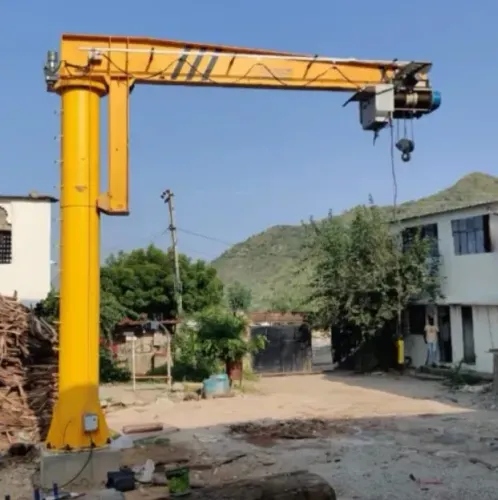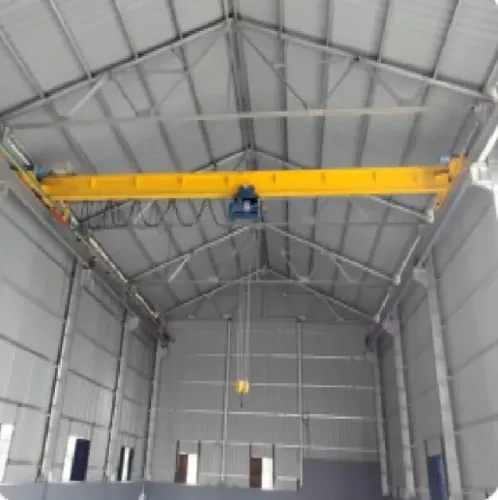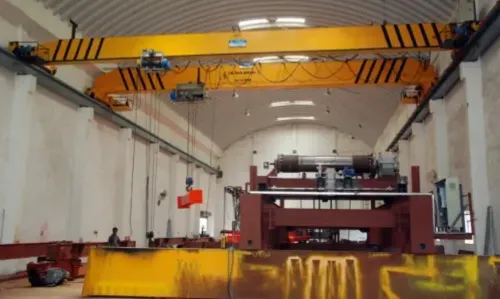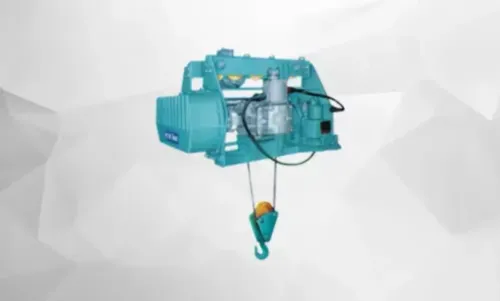
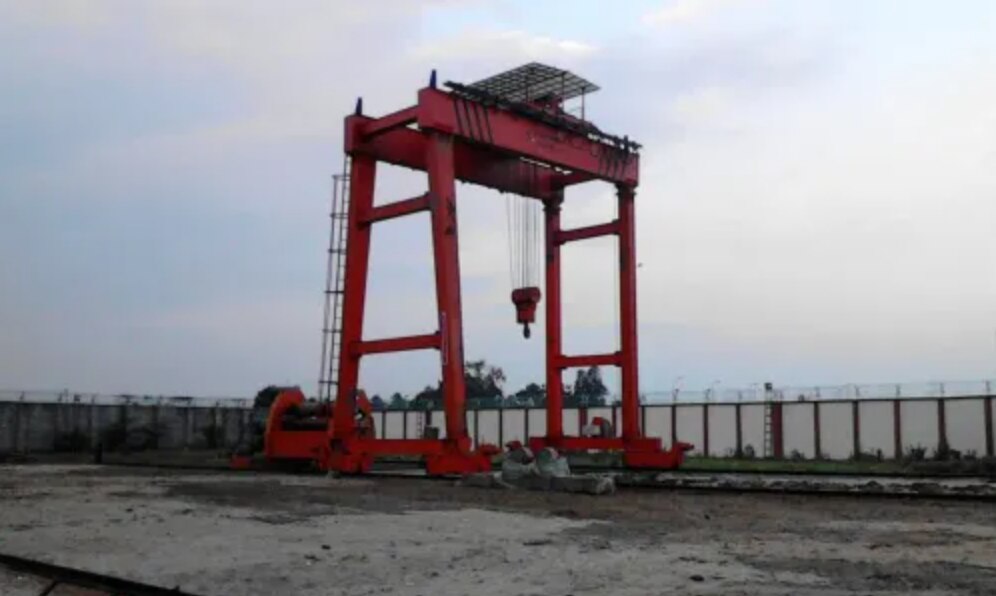
A goliath crane is a rail-mounted gantry crane that carries its bridge on legs travelling along ground-level runways. You will learn how its parts work together, which sites and loads suit it, what to specify before purchase, and which civil, electrical and safety checks determine whether the installation is ready for service.
Key takeaways
- Check rail foundations, drainage, clearances and storm parking before ordering.
- Specify safe working load, span, lift height, duty class and travel speeds.
- Use limit switches, emergency stops, buffers and overload protection in the design.
- Record commissioning tests, inspections, lubrication and wire-rope replacement criteria.
What is a goliath crane, and how is it different from other cranes?
A goliath crane is a gantry crane whose bridge travels on two ground-level rails, supported by legs that move with it. This makes it suitable for yards, workshops and storage areas without building columns. A goliath crane for material handling in Ahmedabad also needs outdoor checks for wind, drainage and storm parking.
Its main parts are:
- Bridge girder: the horizontal structural beam.
- End carriages: frames at each girder end carrying the wheels.
- Wheels: drive and support the crane on the rails.
- Rails: ground-level travel tracks.
- Legs: vertical supports between the girder and end carriages.
- Trolley: the moving frame across the bridge.
- Hoist: the motor, drum or chain mechanism that raises the load.
- Electrical panel: enclosure containing power and control equipment.
- Festoon or cable-reel system: supplies moving electrical power.
- Buffers: absorb end-of-travel impact.
- Limit switches: stop travel or lifting at defined positions.
- Controls: pendant, radio remote or cabin operating devices.
| Crane type | Main difference |
|---|---|
| Goliath crane | Both sides run on ground rails. |
| General gantry crane | Broad category; a goliath is a ground-running gantry. |
| Portal crane | Often another name for a gantry with portal legs. |
| EOT or overhead crane | Bridge runs on elevated runway beams fixed to the building. |
| Semi-goliath crane | One side uses a ground rail; the other uses an elevated runway. |
| Mobile crane | Travels on tyres or crawler tracks, not fixed rails. |
These distinctions help when comparing cranes in Ahmedabad, because foundations, building structure and travel routes differ sharply.
How does a goliath crane perform a lifting cycle, and where does it fit?
A goliath crane completes a lifting cycle by moving the load vertically with its hoist and horizontally with trolley and bridge travel. The operator controls each movement against the load’s weight, centre of gravity and site hazards.
- Check the load weight, centre of gravity and lifting points.
- Select rated slings or a spreader, then inspect and attach them correctly.
- Take slack slowly until the slings seat and the load remains stable.
- Hoist clear of the ground, stopping if the load tilts, snags or swings.
- Cross travel the trolley to position the load.
- Long travel the crane along its ground rails.
- Land the load gently, release sling tension and unhook only after it is stable.
Controls, brakes and limit switches govern acceleration, stopping, upper hook travel and end travel. Press the emergency stop for uncontrolled motion, an obstruction or any unsafe condition; it stops the drive but does not correct a poorly attached load.
Suitable work includes:
- Yard loading and outdoor storage
- Precast-concrete handling
- Steel-stock movement and fabrication bays
- Container and machine movement
- Shipyard handling
Shipyard loads, containers, unusual dimensions and high-wind outdoor lifts need site-specific engineering for stability, wind area, restraints and lifting attachments. This matters in material handling in Ahmedabad and lifting in Ahmedabad, where an indoor specification cannot simply be reused outdoors.
Single-girder and double-girder selection depends on more than capacity.
| Arrangement | Span, headroom and access | Wheel loads and duty |
|---|---|---|
| Single girder | Lower steel weight; suitable headroom and moderate duty | Lower wheel loads where span and access permit |
| Double girder | Better hook approach, platform access and longer-span options | Higher structure and wheel loads for demanding duty |
Can your site accept a goliath crane?
A site can accept a goliath crane only after its geometry, ground and interfaces pass a documented engineering check. Measure the available span, runway length, clear height and hook approach; a short hook approach can leave loads unreachable beside walls, racks or trucks.
- Confirm ground bearing capacity, soil investigation results and foundation design for wheel loads, rail reactions, braking forces, surge forces, storm restraints, buffer impacts and possible derailment loads.
- Set the rail gauge and verify rail level, straightness and parallelism throughout the runway. Provide drainage around rails so water does not pond, corrode components or undermine foundations.
- Assess wind exposure, suspended-load wind area and storm parking. Specify rail clamps or storm locks, buffers and wheel anti-climb arrangements for outdoor service.
- Check incoming power, conductor or cable routing, earthing, lightning protection and electrical-enclosure ingress protection.
- Map installation access, crane erection space and every travel-path obstruction, including columns, walls, drains, pipe racks, vehicles and stored material.
A conventional yard slab does not automatically support a crane runway. Its thickness and reinforcement may suit trucks while failing under concentrated wheel loads, repeated braking, lateral surge or storm-restraint forces; separate runway foundations may be necessary.
For a goliath crane for material handling in Ahmedabad, include Ahmedabad’s Seismic Zone III classification in the project design basis. Check the crane, rails, foundations and building interfaces together where seismic actions apply; an industrial crane in Ahmedabad is not validated merely because the building is structurally approved.
What should you include in the crane specification?
Specify the complete lifted system, not just the heaviest object. For a goliath crane for material handling in Ahmedabad, require these fields:
- Safe working load and maximum occasional load, stated separately, with load combinations and test load defined.
- Duty class selected from ISO 4301-1 using operating cycles and load spectrum, not capacity alone. Record lifts or operating hours per day.
- Span, runway length, lift height, hook approach, hoist speed, cross-travel speed and long-travel speed.
- Control method, indoor or outdoor service, power supply, load dimensions, centre of gravity and every lifting attachment.
The hook block, spreader beam, grab and magnet are part of the lifted system. Add their weights to the lifted load; dynamic effects, off-centre loading and attachment geometry can make the heaviest object an inadequate capacity test.
State whether a single-girder or double-girder arrangement is required after checking span, headroom, hook approach, duty, wheel loads, trolley layout and future upgrades. A double girder can improve hook approach and platform access; a single girder can reduce steel and initial cost in suitable duties.
Name the governing editions of IS 3177 and IS 807, then assign responsibility for design checks, load combinations, inspection, testing and acceptance.
For electrical supply, compare the route before choosing:
| Option | Check | Main concern |
|---|---|---|
| Festoon | Long route and bend radius | Cable wear and inspection access |
| Enclosed conductor bar | Contamination and protection | Collector maintenance |
| Cable reel | Travel length and take-up | Reel torque, cable weight and control |
How should installation, commissioning and maintenance be managed?
Put one responsibility matrix in the contract before fabrication starts. Assign crane design and manufacture, civil foundations, rail gauge and alignment, incoming power, earthing and lightning protection, access platforms, erection logistics, plant interlocks, operator training, spares, and maintenance documents to named parties.
This prevents a complete crane from waiting for an unfinished rail or power connection.
1. Before energising, check rail level, straightness, gauge, wheel travel clearance, structural fasteners, buffers and storm restraints. Run the crane without a load to verify long travel, cross travel, controls, phase sequence and brake operation.
2. Test emergency stops, upper and lower limit switches, travel limits, earthing continuity, hook condition, safety latches and wire-rope condition. Check the load-limiting function where fitted, then complete the rated-load or proof-load test required by the governing edition of IS 3177 or IS 807 and the inspecting authority.
3. Record operator training, test results, defects closed, spare parts, wiring diagrams, manuals, lubrication points and preventive-maintenance frequencies. For outdoor material handling in Ahmedabad, include drainage, enclosure protection, corrosion control and storm parking in the handover file.
A lifting demonstration proves that the crane moved one load; it does not prove rail alignment, earthing, emergency stops or protective-device operation. For lifting in Ahmedabad, inspect wire ropes using ISO 4309 guidance for broken wires, diameter reduction, distortion, corrosion, bird-caging, heat damage and poor spooling.
Hi-Tech Industries can add value when one scope coordinates these site interfaces, erection, commissioning and documents for cranes in Ahmedabad.
Related product
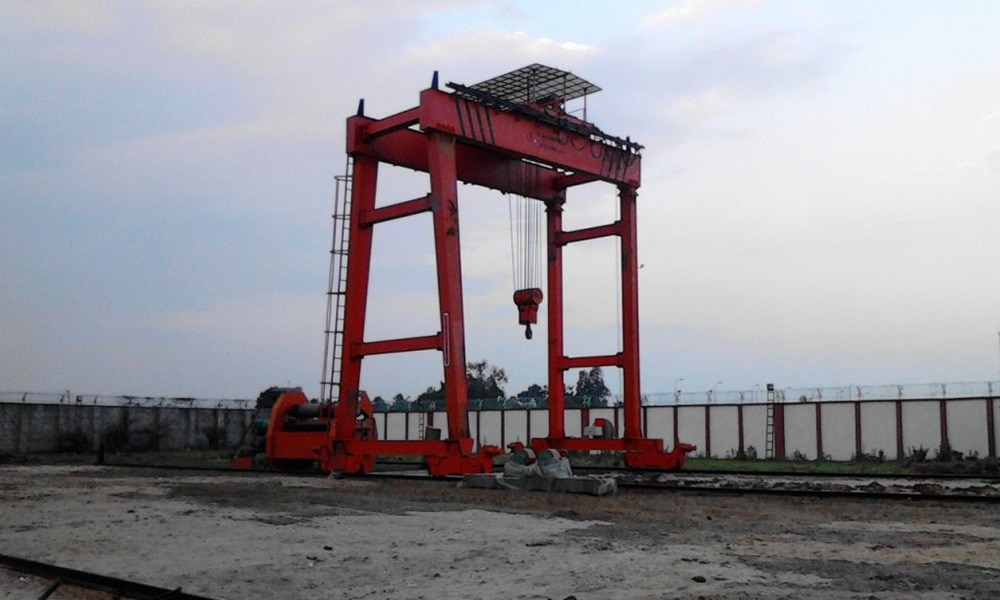 | Goliath Cranes HI-TECH Goliath Cranes are engineered for high-performance heavy material handling, delivering robust reliability, minimal maintenance, and strict... View product → |
Frequently asked questions
What is a goliath crane, and how is it different from other cranes?
A goliath crane is a gantry crane with a bridge supported by legs that travel on two ground-level rails. Unlike an overhead crane, it does not depend on building columns or runway beams.
How does a goliath crane perform a lifting cycle?
The hoist raises or lowers the load, the trolley moves it across the bridge, and the crane travels along its rails to position it. Operators must coordinate each movement within the rated load and site limits.
Can your site accept a goliath crane?
Check rail alignment, foundation capacity, drainage, ground settlement, power supply, travel clearances, wind exposure and a designated storm-parking position before installation.
What should you include in the crane specification?
State the safe working load, span, lift height, duty classification, hook approach, travel and hoist speeds, control method, power supply, outdoor protection and required safety devices.
How should installation, commissioning and maintenance be managed?
Install and align the rails, test unloaded and rated-load functions, verify brakes and safety devices, document commissioning results, and follow a scheduled inspection, lubrication and wire-rope maintenance plan.
Keywords