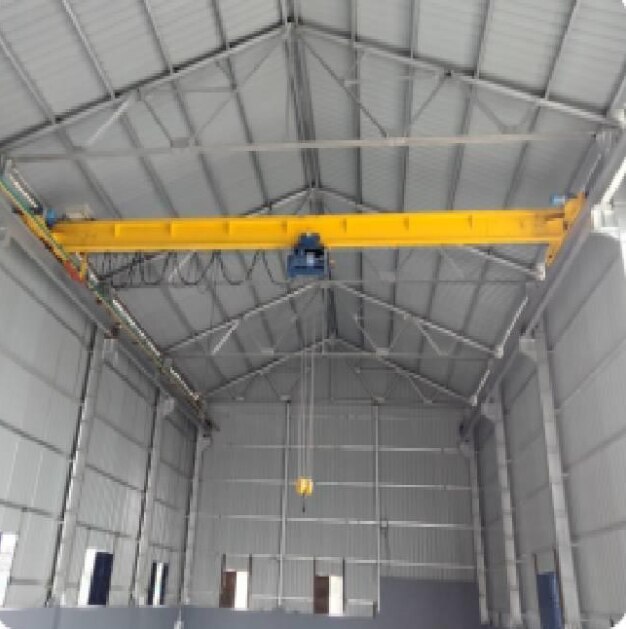
A chain pulley block solves a different lifting problem from an EOT crane: one provides manual point lifting, while the other provides powered movement across a defined path. The right choice depends on load spectrum, travel, frequency, building structure, available power and positioning needs—not rated capacity alone.
Key takeaways
- Choose a chain pulley block for occasional, point-to-point vertical lifting.
- Choose an EOT crane for repeated loads moving across a production bay.
- Compare duty class, power supply, runway structure and operator safety controls.
- Request load data, bay dimensions and installation scope before comparing quotes.
How an EOT crane differs from a chain pulley block
An EOT crane moves a suspended load with powered hoist, trolley and bridge travel; a chain pulley block lifts manually from one suspension point. The EOT crane can carry loads across a bay, while the chain pulley block normally provides slow vertical lifting with little horizontal mobility.
| Option | Operating difference | Best fit |
|---|---|---|
| EOT crane | Powered lifting, trolley movement and bridge travel on runway rails | Repeated production lifting across a bay or between workstations |
| Chain pulley block | Hand-operated chain lifting from a fixed beam, monorail or trolley | Occasional, localised, temporary or low-budget lifting |
For an EOT crane or chain pulley block in Ahmedabad, assess the work pattern before comparing rated capacity. The first decision factors are lifting frequency, travel distance, lift height, number of lifting points, positioning accuracy and duty cycle.
A 5-tonne crane used for occasional maintenance does not need the same hoist, brakes, motors or structural class as a 5-tonne crane repeating production lifts.
Choose the chain pulley block only after verifying its suspension point, beam, monorail or trolley for the full safe working load. An unverified roof member, side pulling, shock loading or a twisted chain can turn simple lifting into an unstable lift.
Choose EOT cranes when manual handling slows throughput, loads cross long distances, or placement must be repeatable; account for runway structure, electrical supply and the risk of one crane becoming a production bottleneck.
When a chain pulley block is the practical choice
A chain pulley block is the practical choice when you lift an occasional load at one fixed point and speed is not the priority. It avoids runway beams, bridge machinery and electrical installation, making it suitable for a low-capital, temporary or portable material handling arrangement.
Choose it when:
- Maintenance teams lift infrequently at a single workstation.
- The site has no electrical supply or no room for EOT crane structure.
- Limited headroom prevents bridge-crane installation.
- A verified beam, monorail, trolley or lifting point already has adequate safe working load.
Never hang the block from an unverified roof member. Confirm the supporting structure, suspension hardware and rated capacity before lifting; a sound chain pulley block attached to weak steel still creates a dangerous lift.
Manual lifting becomes a production constraint when operators repeat the same lift throughout a shift. Its slow hoisting and limited horizontal movement create waiting time, while dragging or side-pulling the load increases instability and can damage the chain, hooks or brake.
Treat it as the wrong tool when:
- Loads travel across a bay or between workstations.
- Throughput depends on rapid, repeated lifting.
- Placement requires powered travel or fine positioning.
- The duty cycle demands continuous heavy service.
Compare lifting frequency, travel distance, lift height, load distribution and positioning accuracy—not rated capacity alone. A chain pulley block suits localized work; repeated movement across several lifting points may justify powered equipment or multiple point devices.
What an EOT crane adds—and what installation really involves
An EOT crane earns its installation effort when lifting is repeated, loads must travel horizontally, or operators need accurate placement across several workstations. A chain pulley block remains cheaper for occasional point lifting, but manual travel and repeated pulls turn material handling into a production constraint.
Do not size EOT cranes from safe working load alone. A 5-tonne crane used for monthly maintenance lifts needs different hoist, brakes, motors and structural duty than one making repeated production lifts; load spectrum and operating frequency set the duty class.
Compare one crane with multiple smaller devices using utilisation, maintenance access, failure consequences and required availability. One crane can streamline lifting, or stop several workstations when it fails.
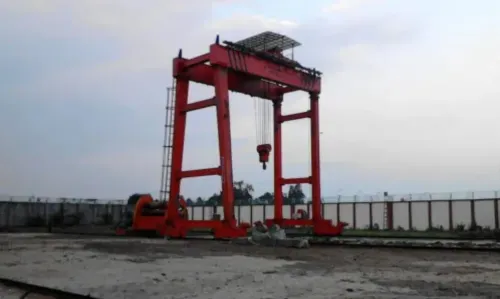
Installation is a complete load path, not just a bridge and hoist. The quotation must account for runway beams, girders, columns or building connections, foundations, aligned rails, end stops and buffers, plus the electrical safety system. That system includes an isolator, conductor system, overload protection, emergency stop, travel limits, hoist limits and a load-holding brake.
Variable-frequency drives improve positioning; they do not replace brake capacity or correctly set limits.
Before acceptance, require:
- Dimensional and rail-alignment checks, unloaded and loaded travel, wheel tracking and hook approach
- Brake holding, emergency-stop, control-direction and every limit-switch test
- Electrical insulation checks, abnormal-noise inspection and load-test records
- Approved drawings, structural calculations, certificates, schematics, operating instructions, lubrication schedule, spares list and a crane register showing safe working load
Compare total cost, duty class and operating risk
A 5-tonne rating does not make two lifting options equivalent. Compare the purchase, installation, labour, maintenance, downtime and failure consequences over the equipment’s working life.
| Option | Total ownership cost | Duty-class suitability | Operating risk |
|---|---|---|---|
| EOT crane | Higher initial cost for runway or structure, electrification, installation, testing and maintenance; lower handling labour for repeated moves | Specify SWL, span, lift, hook approach, headroom, speeds and required duty separately for bridge, trolley, hoist, motors and brakes | Powered travel improves throughput and positioning, but a single crane can stop several workstations when it fails |
| Chain pulley block | Lower purchase cost and no runway or power supply; manual labour rises with lift frequency, travel distance and load weight | Suits occasional, localised lifting; it becomes a production constraint during repetitive or high-throughput work | Inspect the load chain, hand chain, hooks, latches, load sheave and brake; side pulling, shock loading or a twisted chain can destabilise the load |
For an EOT crane or chain pulley block in Ahmedabad, state the classification basis before comparing quotations: IS 807 and IS 3177, or a clearly identified FEM or ISO class. Match the class to load spectrum and operating frequency, not SWL alone. Two 5-tonne EOT cranes can need different hoists, brakes, motors and structures.
Include inspection access, spare parts, operator time and downtime in the calculation. A high-duty hoist on a lightly rated runway does not create a high-duty crane.
Use this Ahmedabad facility selection checklist before requesting quotes
Before requesting quotes for an EOT crane or chain pulley block in Ahmedabad, record the lift rather than only its rated capacity. Use this checklist:
- State maximum load, normal load, load dimensions, lift height, hook approach, and required positioning accuracy.
- Record lifts per hour, hours per shift, shifts per day, travel distance, number of lifting points, and production consequences of downtime.
- Describe the load spectrum: occasional maintenance lifts differ from repeated production lifts, even at the same tonne rating.
- Specify IS 807 and IS 3177, or a clearly stated FEM/ISO classification. Require the supplier to state the duty class for the bridge, trolley, hoist, motors, brakes, runway and supporting structure.
- For a chain pulley block, verify the suspension beam, monorail, trolley or lifting beam’s safe working load. Never attach it to an unverified roof member.
- Provide runway elevations, column locations, headroom, building clearances, incoming power, earthing, maintenance access, unloading routes, civil-work responsibility and available shutdown window.
- Ask for load-test documentation, operating instructions, inspection intervals, spare-parts access and emergency arrangements.
Hi-Tech Industries can use these interface details to distinguish a production crane from a point-lifting device before fabrication begins.
| Option | Verify before ordering | Consequence of getting it wrong |
|---|---|---|
| EOT crane | Runway capacity, travel coverage, duty class and power supply | Bottlenecks, structural overloading or costly site changes |
| Chain pulley block | Suspension point, lift height and manual travel requirement | Unsafe support or slow material handling |
A single EOT crane may serve several points, but compare its failure impact and utilization with multiple smaller devices.
Related product
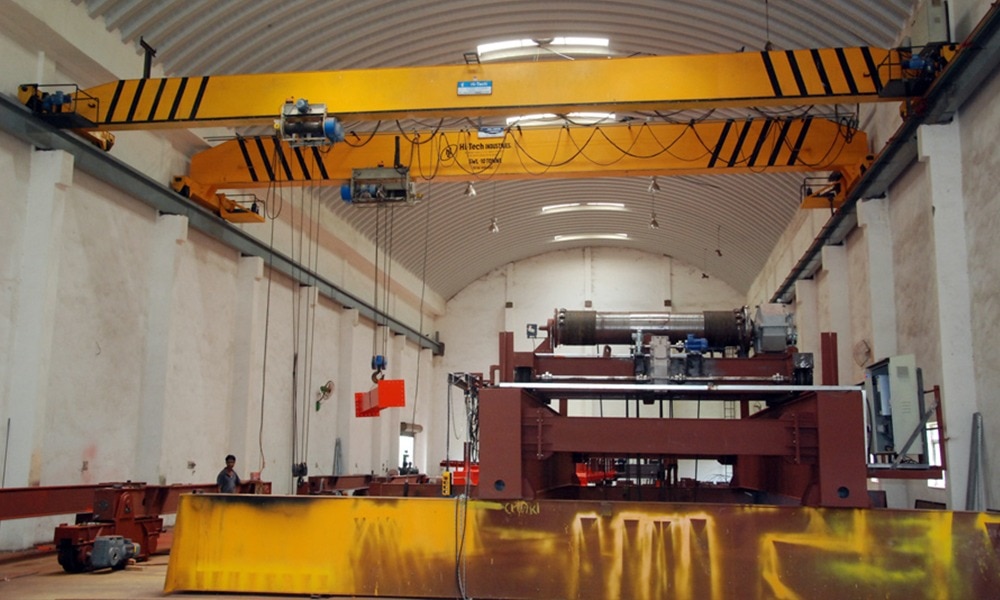 | EOT Crane Established in 1989, HI-TECH is a leading manufacturer and exporter of EOT (Electric Overhead Traveling) cranes and material handling equipment based... View product → |
Frequently asked questions
What is the main difference between an EOT crane and a chain pulley block?
An EOT crane uses a powered hoist, trolley and bridge to move loads across a bay. A chain pulley block lifts manually from one suspension point.
When is a chain pulley block the practical choice?
Use a chain pulley block for occasional vertical lifting where slow speed, limited travel and manual operation meet the facility’s needs.
What does installing an EOT crane involve?
Installation involves checking the building structure, fitting runway beams and rails, installing bridge and hoist equipment, connecting power, testing controls and commissioning the crane.
What should Ahmedabad facilities compare before requesting lifting-equipment quotes?
Compare safe working load, lifting height, travel distance, duty class, operating cycles, power supply, structural work, maintenance access and safety controls.
Keywords