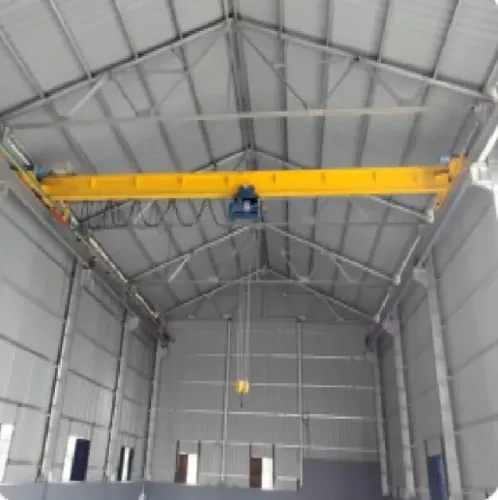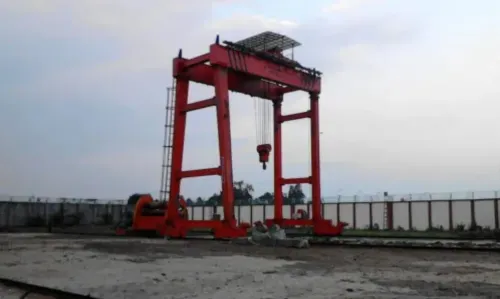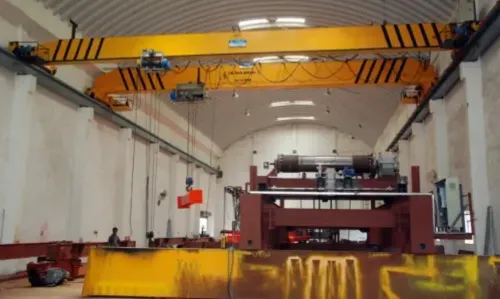
A jib crane can make a machine-loading bay faster and safer, but only when its outreach, foundation, hoist, controls and operating envelope match the actual workstation. By the end, you will be able to compare crane types, calculate the capacity you really need, check the supporting structure and specify an acceptance-ready installation.
Key takeaways
- Measure load weight, lifting height, reach and rotation before selecting a jib crane.
- Use a chain pulley block for occasional light lifts, not repetitive production handling.
- Check floor slab, wall structure or foundation design before ordering the crane.
- Include installation, load testing, manuals, drawings and operator training in the handover.
Match the Jib Crane to the Workstation
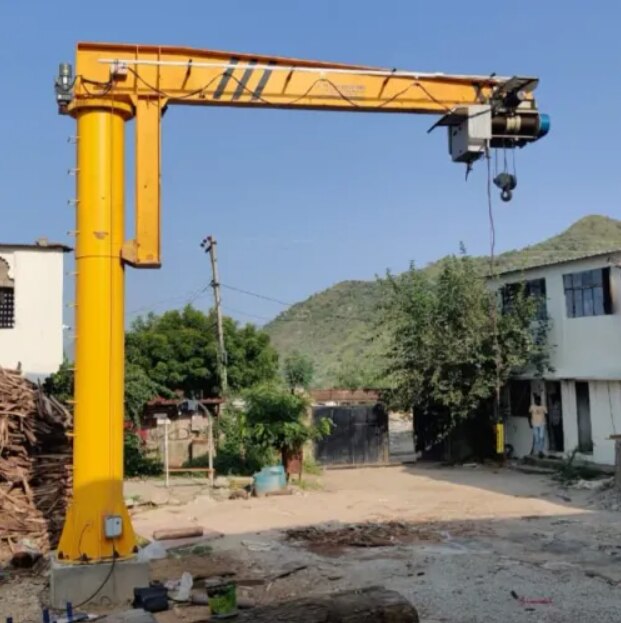
A jib crane improves lifting at one workstation by bringing the hoist directly over the load. Its horizontal jib or boom carries a trolley and hoist, while a vertical mast or column supports the assembly and allows the boom to rotate through a specified arc.
This suits machine loading, die handling, welding fixtures, maintenance bays and assembly cells where repeated short lifts cause manual-handling injuries or slow production.
| Configuration | Space and support needed | Best workstation fit |
|---|---|---|
| Pillar-mounted | Clear floor area, a designed foundation and full slewing clearance | Fixed machine loading, dies and maintenance bays |
| Wall-mounted | A verified RCC wall or steel column, with no obstruction through the slewing arc | Workstations beside structurally sound walls or columns |
| Base-mounted | A bolted base or engineered foundation; compact models need protected floor space | Assembly cells and loading points without a suitable wall |
| Mobile | Level travel route, adequate floor capacity and stabilisation during lifting | Occasional lifting across several nearby stations |
For jib cranes in Ahmedabad for lifting, do not treat available floor area as proof that installation is possible. Before drilling, check slab thickness, reinforcement, concrete grade, edge distances, cracks and buried services; a structural survey and approved anchor or foundation design are separate from crane fabrication.
During lifting in Ahmedabad, keep the load within the rated chart for its outreach and trolley position: a 1-tonne rating does not automatically permit 1 tonne at every point of the boom.
Choose the Right Crane, Hoist or Manual Lifting Tool
Choose a jib crane when one workstation needs a short, controlled lift rather than full-building coverage. Select the support and power method against the load path, travel pattern and structure.
| Option | Choose it when | Do not choose it when |
|---|---|---|
| Pillar-mounted jib | A dedicated floor position needs 180°–360° rotation and repeated machine loading or die handling. | The slab or foundation cannot resist overturning forces. |
| Wall-mounted jib | A sound reinforced wall or steel column can carry the bracket, and floor space is limited. | The wall’s reinforcement, thickness or local strength is unverified. |
| Mobile jib | You need occasional lifting at different bays and can move the unloaded crane safely. | Production needs fixed, frequent cycles or the floor is uneven. |
| Base-mounted jib | You need a relocatable workstation without excavating a permanent foundation. | Anchors cannot be designed for the base and horizontal forces. |
| EOT crane | Loads travel across multiple bays, spans, and lifting points. | One station is the only requirement; runway cost and headroom add no value. |
| Goliath crane | Outdoor or open-floor lifting needs legs and movement along rails. | Fixed workstation access is enough. |
| Monorail | Loads follow one defined route between repeatable processes. | Operators need broad slewing or access across a bay. |
| Forklift | Palletised loads must move horizontally and stacking is central. | Suspended-load positioning beside a machine is required. |
| Chain pulley block in Ahmedabad | Lifting is intermittent, manual and slow, with the operator clear of the load. | Repetitive production makes fatigue and cycle time important. |
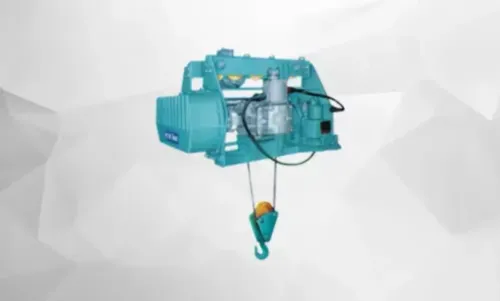
| Electric hoist | Powered, repeatable lifting needs precise load control, usually mounted on a jib or monorail. | Power, controls and safe isolation are unavailable. |
For material handling in Ahmedabad, make unloading, erection, cabling, earthing, testing, training and handover responsibilities explicit. A “chain block included” note is not enough; request rated load, lift, hook dimensions and proof-test records.
Specify Capacity, Reach and Duty Without Guesswork
A safe jib crane rating must cover the heaviest load at the greatest outreach, during starting, stopping and slewing—not just the hoist’s nameplate capacity. For jib cranes in Ahmedabad for lifting, require calculations for the complete working envelope and the supporting structure.
| Input | Specify or verify | What goes wrong if missed |
|---|---|---|
| Rated load | Maximum working load, including lifting beam, hook block and attachments | The hoist lifts the load, but another component overloads |
| Reach | Maximum hook outreach and usable rotation range | Capacity at the boom tip is assumed instead of checked |
| Duty | Lifts per hour, average running time, load spectrum, starts per hour, ambient temperature and duty class | A high-cycle electric hoist overheats or wears prematurely |
| Structure | Self-weight, dynamic effects, vertical and horizontal reactions, overturning moment, anchor-bolt forces and required concrete-foundation capacity | The floor, foundation or anchor group fails even though the hoist is correctly rated |
Treat the safe working load as a limit for the entire load path. Ask for identification and capacity of the hook, sling, shackle, trolley, boom, column, welds, anchor rods and supporting structure; the weakest item governs.
For material handling in Ahmedabad, the quotation should show the calculation at the worst operating position, not only a single SWL figure. A larger column or boom does not prove that an existing RCC floor can resist the base-plate forces, grout stresses and overturning moment.
Require the supplier to state the design assumptions, load combinations and foundation requirements before approving fabrication.
Verify the Floor, Wall or Foundation Before Installation
A safe jib installation is proven by a load-path calculation, not by the crane’s one-tonne label. Check how the vertical reaction, slewing force and overturning moment travel through the boom, column, base plate, anchor rods, grout and supporting structure.
1. Obtain the supplier’s design calculation showing maximum working load, outreach, hoist and trolley position, jib self-weight, dynamic effects, maximum base moment, shear and axial reactions, anchor-bolt forces, and required concrete-foundation capacity. Check the load chart at every intended radius; a one-tonne rating does not automatically apply at full outreach.
2. Have a structural engineer survey the support. For an RCC floor, record slab thickness, concrete grade, reinforcement layout, edge distances, cracks, openings and buried services before drilling. For a steel column, verify section size, steel grade, local buckling, connection capacity and load transfer into the frame.
3. For a wall mount, verify wall material, thickness, masonry condition, reinforcement, bracket spacing and the forces at every fixing. Do not use a wall-mounted jib on unverified blockwork.
4. For a new freestanding jib, require a foundation drawing specifying footing dimensions, reinforcement, concrete grade, anchor-rod size and embedment, grout thickness and curing requirements. A foundation design is a separate deliverable from crane fabrication.
For lifting in Ahmedabad, retain the signed survey, calculation, approved anchor or foundation design and installation records. If the existing support cannot resist the calculated moment, enlarge the foundation or provide a designed steel transfer frame; simply increasing column or boom size does not fix the load path.
Make the Ahmedabad Procurement and Handover Scope Complete
Put every interface in the purchase order, not in an assumption between the manufacturer and installer. For jib cranes in Ahmedabad for lifting, assign one party responsibility for unloading, storage, erection, electrical isolation, power cabling, earthing, testing, training and statutory submission.
- Name the applicable code as IS 15419:2004, including its edition, and require design, fabrication, examination and testing against it.
- Request calculations showing maximum working load, outreach, self-weight, dynamic effects, overturning moment, anchor-bolt forces and required foundation capacity.
- Identify the safe working load and serial number for every load-path component: hook, sling, shackle, trolley, hoist, boom, column, weld, anchor group and supporting structure.
- Require material certificates, weld inspection records, dimensional drawings, a test certificate and a nameplate showing capacity, serial number and duty classification.
- State who will unload, erect, align, connect power, provide earthing, isolate the supply and commission brakes, emergency stops, travel limits and slewing limits.
- Specify a witnessed no-load and rated-load test, with signed results and correction of every defect before acceptance.
- Obtain operator and maintenance training, inspection schedules, spare-parts details, the competent person’s examination report and statutory documentation in the handover file.
For electric equipment, give the manufacturer in India lifts per hour, running time, load spectrum, starts per hour, ambient temperature and duty class; maximum load alone can overheat a high-cycle crane. Hi-Tech Industries is one supplier to ask for a single accountable turnkey scope rather than separate supply and installation promises.
Related product
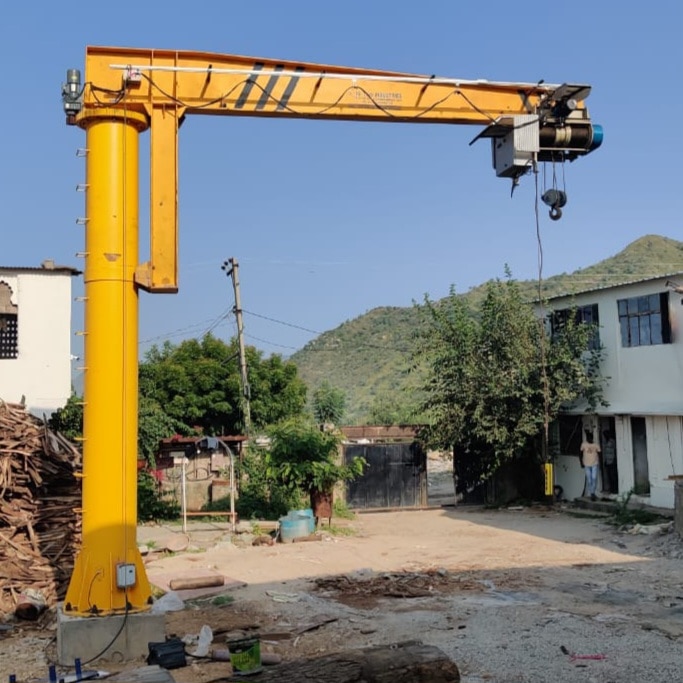 | JIB Crane Engineered for precision material handling, the Hi-Tech Jib Crane delivers high-rigidity lifting solutions customized for industrial environments. View product → |
Frequently asked questions
How do you match a jib crane to a workstation?
Map the load path, pickup and placement points, required rotation arc, lifting height, available headroom and operator access. Select a mast, wall-mounted or foundation-mounted arrangement that keeps the load within the rated working area.
When should you choose a jib crane instead of a hoist or manual lifting tool?
Choose a jib crane for repeated lifting within one workstation. Use a chain pulley block for occasional lifts where speed and precise positioning are less important; use a larger crane system when loads travel between multiple workstations.
What details are needed to specify a jib crane correctly?
Provide the safe working load, maximum load including lifting accessories, horizontal reach, hook height, rotation angle, lift speed, duty cycle, operating frequency, power supply and environmental conditions.
What must be checked before installing a jib crane?
Verify the floor slab, wall or foundation can resist the crane’s vertical, horizontal and overturning forces. Confirm anchor locations, concrete strength, baseplate dimensions, clearances and access for installation.
What should an Ahmedabad jib crane handover include?
Require approved drawings, load-test records, inspection certificates, operating and maintenance manuals, safety instructions, spare-parts details, operator training and a documented commissioning sign-off.
Keywords